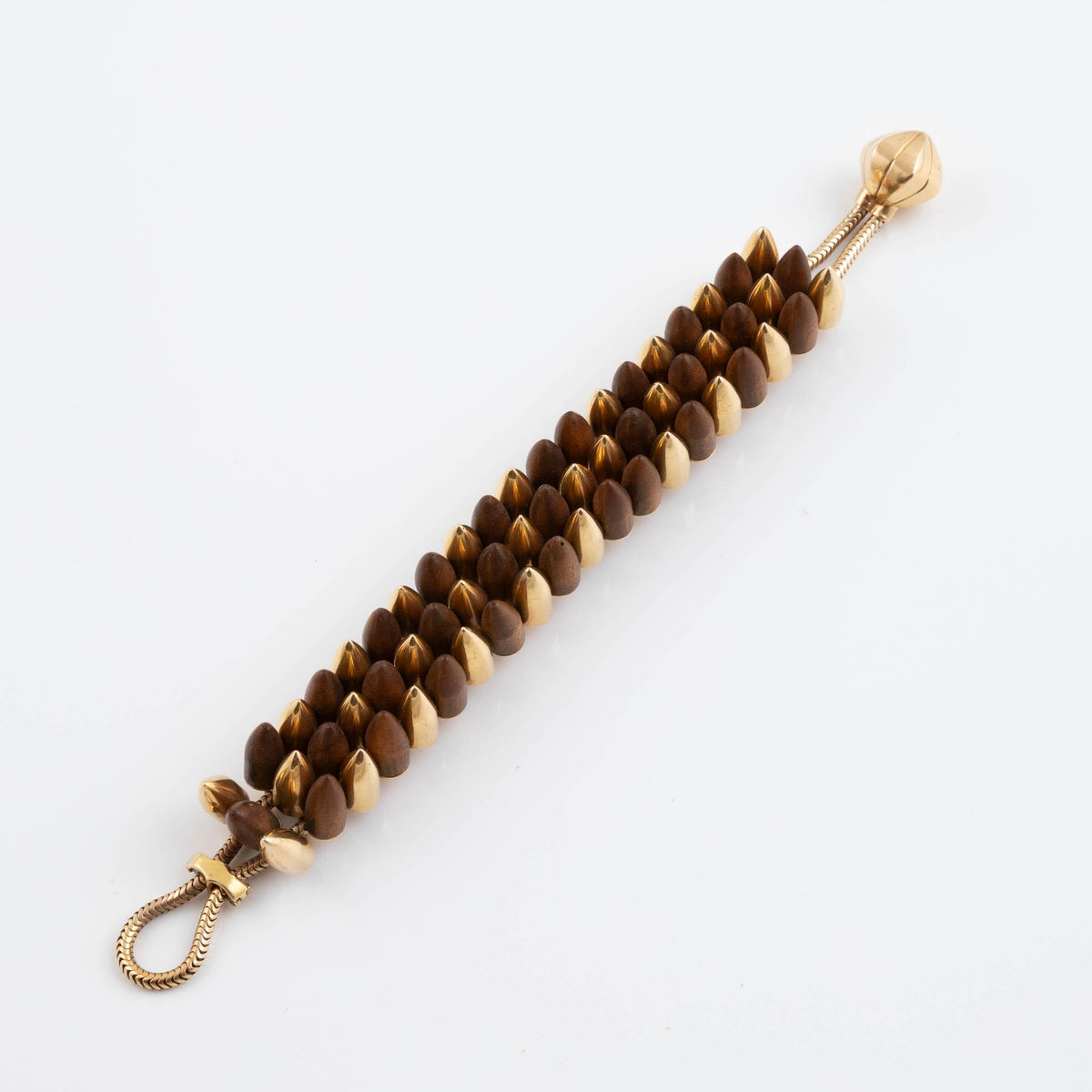


Gold and Wood Bracelet by Paul Flato, New York, circa 1937
Gold and Wood Bracelet by Paul Flato, New York, circa 1937
A flexible bracelet composed of three rows of bullet-shaped elements alternating polished gold and cocobolo wood mounted with sliding links on an articulated chain; with a ball and loop clasp; mounted in 14-karat yellow gold; in original fitted Paul Flato box
- Signed Flato
- Measurements: 6¼ x ¾ inches
Biography
Paul Flato was the original jeweler to the stars, catering to the crème de la crème of Hollywood. He founded his company in New York City in 1928 and opened a Los Angeles store in 1937. His figurative style, often bordering on humorous, reached its peak in the 1930s when Adolph Kleaty, George Headley, and Fulco, Duke of Verdura, designed pieces for him. Flato closed his business in 1943.
Significance
In the 1930s and 1940s, Paul Flato’s expressive, daring style contrasted with the conventional diamond designs available and appealed to the height of fashionable society. His salons were frequented by Joan Crawford, Marlene Dietrich, and Vivien Leigh, and leading men Douglas Fairbanks, Laurence Olivier, and Orson Welles. His jewelry was worn by Katherine Hepburn in Holiday, Greta Garbo in Two Faced Woman, and Rita Hayward in Blood and Sand. Flato had brilliant ideas and oversaw gifted designers Adolph Kleaty, George Headley and Fulco di Verdura, who manifested his creative energy with incredible designs.
Head of design, Kleaty created elegant “drippy” pieces with scrolls and natural elements. Headley had a feeling for bows and swags and the movement of ornamented pieces. Fulco di Verdura, however, had an eye for the truly unusual both in design and materials. He was responsible for the design of Flato’s Cole Porter Belt Necklace, one of the most important jewelry pieces ever made and a clever reimagining of an everyday object. Both for Flato and later under his own name, Verdura was drawn to modern designs with a strong sense of both color and movement. This unusual bracelet was likely designed by Verdura. The contrast of polished gold against cocobolo rosewood and the reimagining of bullet-shaped elements as jewelry point to his unusual creativity. Wood was a rare choice for Flato, but Verdura would go on to use the rare cocobolo material in several designs under his own name.
This important piece of design is remarkable for the unique bullet-shaped design and unusual material choice, contrasting rare hardwood with polished gold. Mounted on an articulated chain with sliding links, the bracelet wraps easily around the wrist. The closure is an ingenious ball and loop design that could be worn above or below the wrist, depending on the desired look. The underneath of this meticulously constructed bracelet is just as wonderful as the top, a marker of a true jewel. This iconic bracelet design would be an important and wearable centerpiece to any collection.