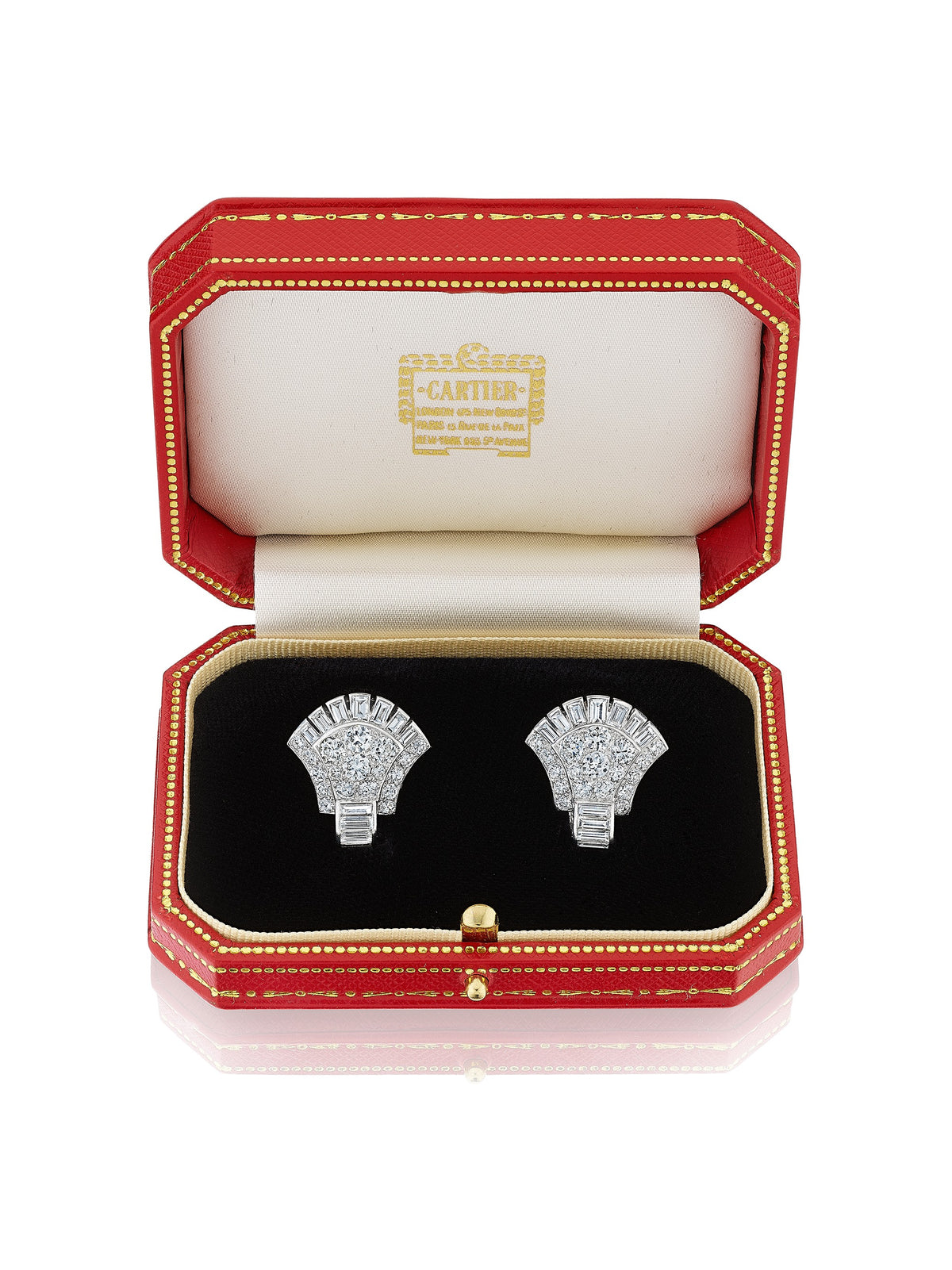


Art Deco Egyptian Revival Diamond Lotus Flower Ear Clips by Cartier, London, circa 1930
Art Deco Egyptian Revival Diamond Lotus Flower Ear Clips by Cartier, London, circa 1930
A pair of ear clips, each composed of a stylized lotus flower composed of a baguette diamond stem topped by a fan-shaped bloom of round diamonds ending in a radiating spread of baguette diamonds; mounted in platinum and white gold, with assay marks; in a fitted box
- Signed Cartier London and numbered, stamped JC for Jacques Cartier
- Measurements: 4/5 x ¾ x 2/5 inch
Biography
Cartier was founded in Paris in 1847 by Louis-François Cartier. His three grandsons, Louis, Pierre, and Jacques, built the house into a famous international jewelry empire serving royalty, Hollywood stars, and socialites. Cartier has created some of the most important jewelry and objects of art of the twentieth century with many iconic designs such as mystery clocks, Tutti Frutti jewelry and the Panthère line. In 1983, The Cartier Collection was established with the objective of acquiring important pieces that trace the firm’s artistic evolution. Today, Cartier has 200 stores in 125 countries.
Significance
Obelisks, pyramids, scarabs, sphinxes, and lotus flowers have inspired designers for centuries. The first wave of Egyptomania arrived in 1789 as Napoleon excavated in Egypt, and a resurgence gripped society during the Art Deco period in the 1920s when Howard Carter discovered King Tutankhamen’s tomb. Cartier created jewelry inspired by objects from the excavation, and sometimes even combined ancient artifacts in modern settings. The romance and rare beauty of Cartier’s Egyptian Revival pieces has made them some of the most desirable Art Deco designs.
One of the markers of a great piece of Art Deco jewelry is the reliance on geometric forms as the aesthetic core of the design. Delicate swags and festoons from earlier eras were replaced with bold modern forms. The flowers, leaves, and stems of traditional naturalistic motifs became abstract and stylized squares, circles, and rectangles. The glittering stones used as texture were secondary to the overall composition. The designers at Cartier were encouraged to peruse the rare book library where design books like Owen Jones’s the Grammar of Ornament brought design motifs from around the world to the design desk. Jones explored Egyptian motifs at great depths, showing particular favor to flared forms of lotus and papyrus flowers.
This extraordinary pair of diamond ear clips is a sleek and modern Art Deco representation of an Egyptian lotus flower. Pavé-set round diamonds indicate the body of the bloom, while baguette diamonds represent the stem and the flare at the opening. The jewel is deeply connected to history and distilled to the pure geometry of circles and rectangles realized in diamonds. The lotus represents creation and rebirth as it closes at night and reopens every morning. The tapered fan form is joyful and full of movement. These Lotus Flower Ear Clips are a rare and desirable example of a Cartier Egyptian Revival piece created to capture the excitement of the Art Deco period.
A page of lotus and papyrus flower designs from Owen Jones, The Grammar of Ornament, 1856, inspired by Ancient Egyptian artifacts.