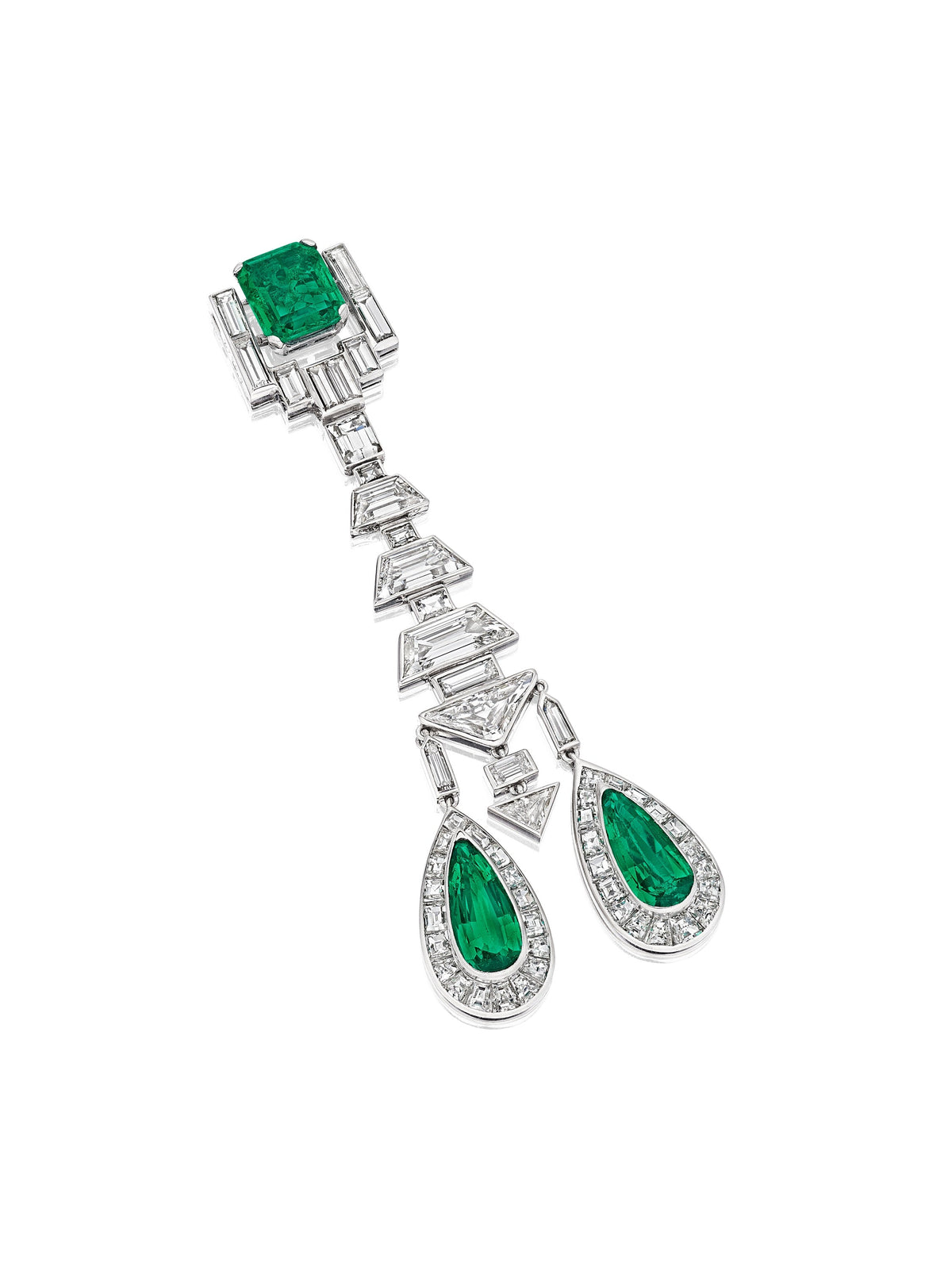


Art Deco Diamond and Emerald Necklace/Brooch by Van Cleef & Arpels, Paris, circa 1928, Manufactured by Rubel Frères
Art Deco Diamond and Emerald Necklace/Brooch by Van Cleef & Arpels, Paris, circa 1928, Manufactured by Rubel Frères
A necklace composed of graduating swags of old and brilliant-cut diamonds accented with baguette diamond centers; the pendant brooch suspending two pear-shaped emeralds with a surround of carré-cut diamonds from a line of baguette and fancy cut diamonds surmounted by a rectangular emerald, the clasp accented with trapezoid emeralds; mounted in platinum, with French assay marks; in original fitted Van Cleef & Arpels case
- Emeralds, total weighing approximately 7.1 carats
- Diamonds, total weighing approximately 22 carats
- Signed Van Cleef & Arpels, Paris, and numbered, makers mark for Rubel Frères
- Circumference: 16½ inches, pendant: 3¼ inches
Provenance
Shirley Bassey
Biography
Van Cleef & Arpels was founded in 1906 by Alfred Van Cleef and his two brothers-in-law, Charles and Julian Arpels, at 22 Place Vendôme, Paris. Their important design innovations include the invisible setting, the minaudière and the Zip necklace. In 1939, they opened an office in Rockefeller Center in New York, moving three years later to 744 Fifth Avenue where they are today. Their impressive client list includes royalty, socialites, and Hollywood stars such as Jackie Kennedy, Princess Grace, Liz Taylor, and the Duchess of Windsor. In 1999, Van Cleef & Arpels became part of the Richemont Group. They have locations in the Americas, Europe, and Asia.
Significance
The 1925 Exposition Internationale des Arts Décoratifs et Industriels Modernes in Paris presented a new design paradigm across the arts. Boucheron, Cartier, and Van Cleef & Arpels, the crown jewelers of Europe and favorites of the rue de la Paix, joined artist jewelers including Jean Fouquet and Raymond Templier to create a style free of court references and old- fashioned prototypes. The new style was characterized by geometric shapes, and sharp color juxtapositions influenced by the straight lines of Cubism. The style later became known as Art Deco, the name derived from a contraction of the exposition title.
Van Cleef & Arpels won a grand prix at the exposition for their astonishing presentation of a jewel manufactured by the workshop Rubel Frères, a team of brothers originally from Budapest who worked closely with the firm on high jewelry in the 1920s. They also manufactured a famous emerald and diamond manchette Van Cleef & Arpels created for Daisy Fellowes around the same time as they manufactured this phenomenal necklace. Designed as a series of undulating waves, each accented by a baguette, this necklace balances fluidity with the desire for clear geometry in the Art Deco era. The pendant can be removed and worn as a brooch, highlighting the unusual, stacked geometry of the diamonds meant to draw the eye to the beautifully colored emeralds at the pinnacle and suspended from the piece.
This necklace was unlike anything that had come before. The beautifully constructed pavé-set waves juxtaposed with the flat baguettes create a glitter and sparkle meant to stand out against the slinky silhouette of Art Deco evening gowns while the magnificent emeralds draw the eye with color and movement. The necklace was owned by Dame Shirley Bassey, a Welsh singer known for her powerful voice. One of the best-selling artists of all times with a career spanning 70 years, she sang three Bond themes, including, fittingly, “Diamonds are Forever.” This incredible necklace with an impeccable provenance would be an important centerpiece for any collection.