Literature
Mouillefarine, Laurence and Véronique Ristelhueber. Raymond Templier: La bijou moderne. Paris: Norma Éditions, 2005, p. 58.
Biography
Modernist jeweler Raymond Templier, is known for his geometric compositions, which drew inspiration from modern technology. Templier said, “When I walk through the streets, I see ideas for jewelry everywhere—wheels, cars, the machines of today, I am ready to respond to all of them.” Born into a dynasty of Parisian jewelers—Maison Templier et Fils, founded by his grandfather in 1849—Templier joined the family business in 1922 and began creating his unusual jewels. He regularly participated in international exhibitions and was involved in the contemporary art movement in Paris, where he was a founding member of the UAM, Union des Artistes Modernes. In 1935, he took over the management of the firm, which remained opened until 1965.
Significance
Raymond Templier conceived each jewel he designed as a volume in space. Like a large sculpture, he considered the play of light and dark against the curves and contours of layered geometric forms. When he inherited his family jewelry company in 1922, his work became radically modern, eschewing superfluous decoration and celebrating clean, streamlined forms. He was a founding member of the Union des Artistes Modernes (U.A.M.), an influential group of French artists and architects including Robert Mallet Stevens, Gérard Sandoz, Jean Fouquet, and Le Courbusier, who embraced industrial influences and celebrated functionality.
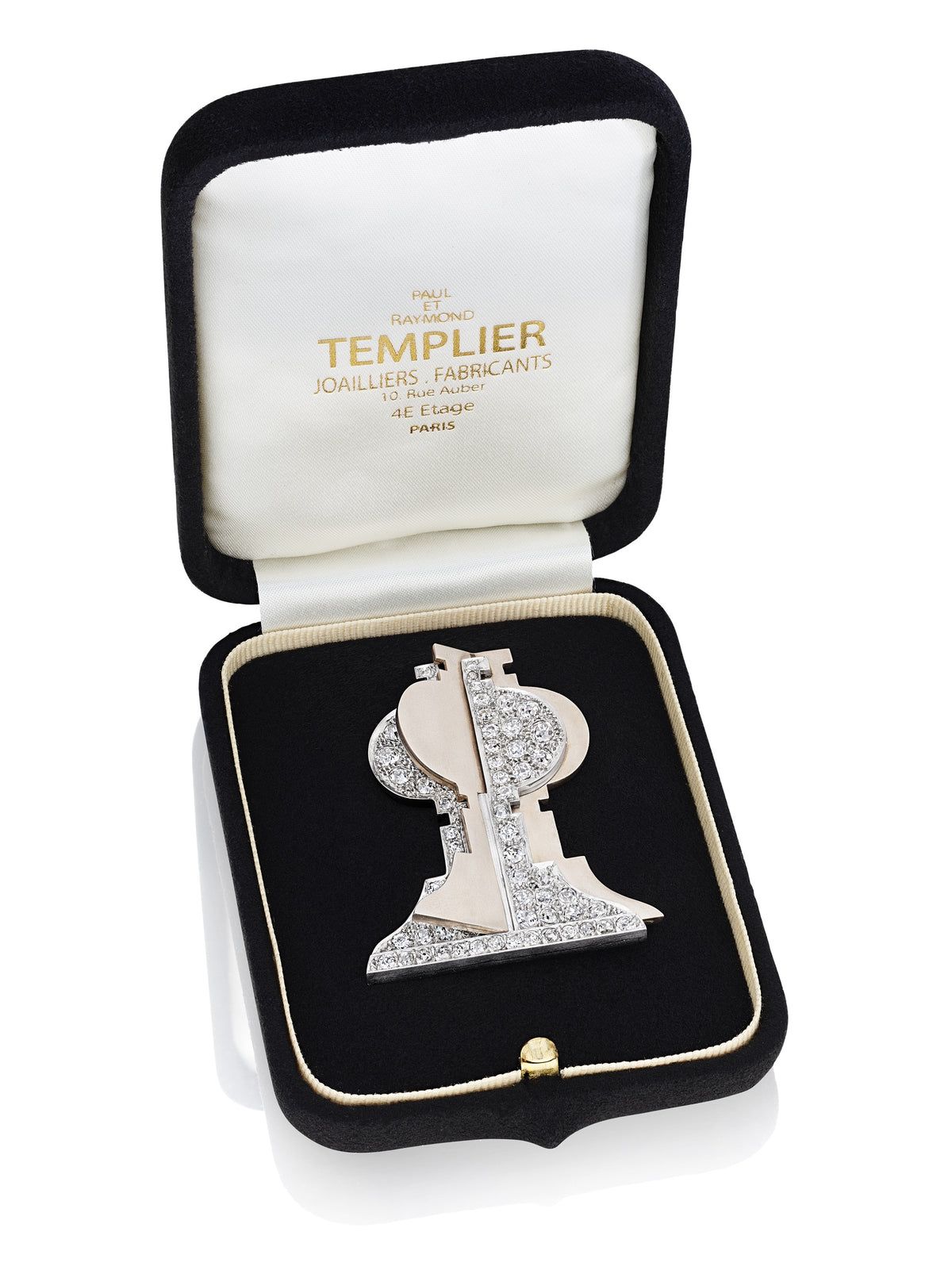
Templier often worked in an all-white palette, as in this chessman brooch, exploring the interplay of light and shadow between polished and pavé surfaces. He was fascinated with games, accepting commissions for boxing belts, various sports trophies, and creating posters for the Tennis Federation. For this jewel, Templier was inspired by chess, a game of strategy and logic with ancient roots that evolved over time and location moving from India to Persia to the Western World, eventually becoming the game we have today. In the Art Deco period, when Templier made the brooch, chess was an elegant leisure time activity featured on ocean liners, resorts, and in glamorous conferences.
To win a game in chess a player must checkmate the opponents king, placing the piece in a position of capture that has no escape. The King, surmounted by a cross, symbolizes authority, power, and vulnerability. Templier beautifully rendered the king in brooch form with overlapping segments creating a sense of movement and dimensionality. He said, “The composition of a jewel must be both free, dynamic, and condensed, enclosed.” Without a superfluous element, the brooch is a masterpiece of Art Deco design allowing light and shadow to create volume. The French publication Le Figaro summed up his achievements, “His works are of such undisputed quality that, even though they were thoroughly representative of our era, they will never go out of fashion. This exceptional chessman brooch would be the undisputed king of any collection.