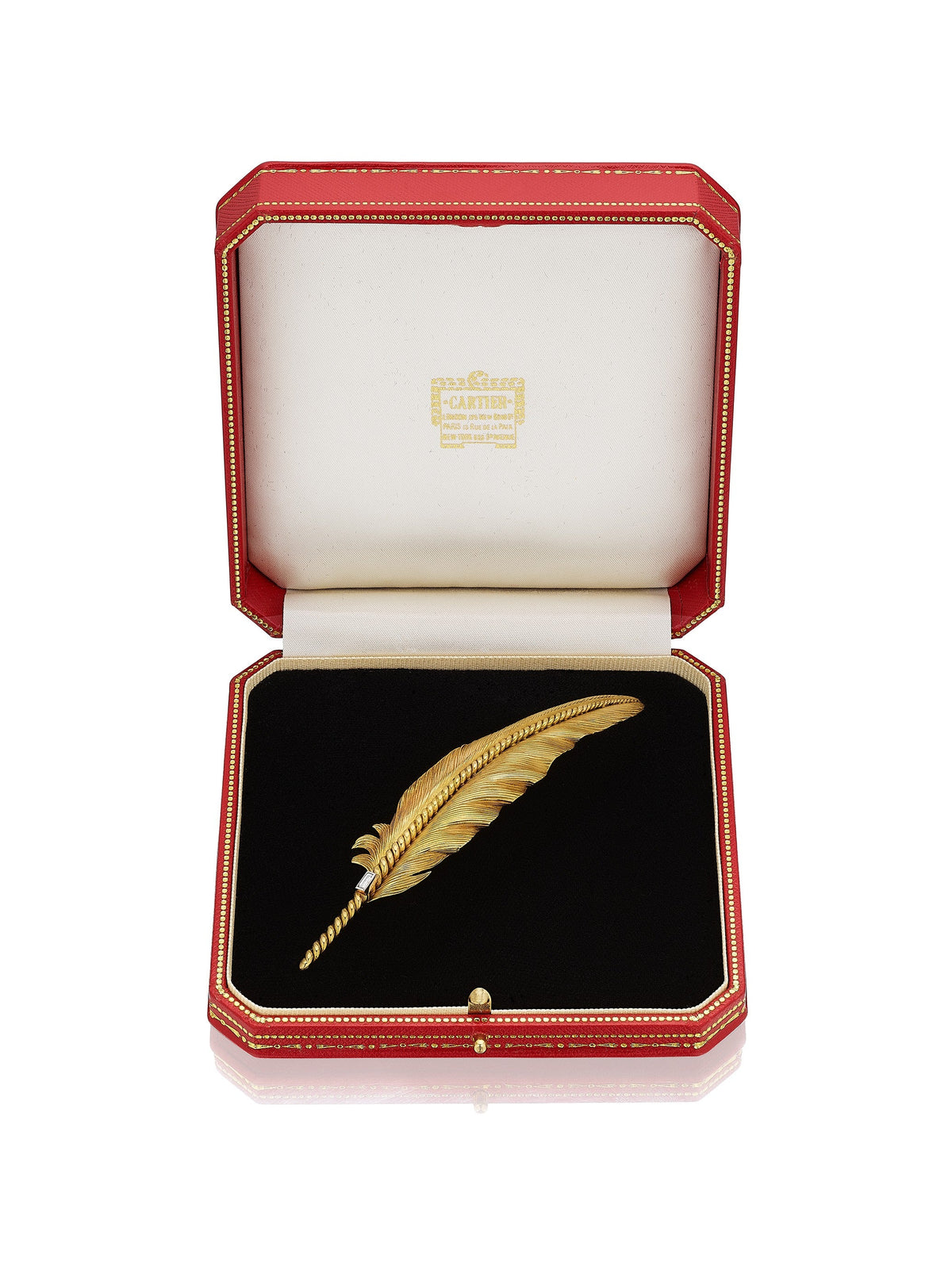


Gold and Diamond “Plume” Brooch by Cartier, Paris, circa 1940
Gold and Diamond “Plume” Brooch by Cartier, Paris, circa 1940
A brooch in the form of a feather with a rachis of twisted gold, accented with a baguette diamond; in 18-karat yellow gold, with French assay marks; in a fitted box
- 1 baguette-cut diamond
- Signed Cartier, Paris and numbered
- Measurements: 4¼ x ¾ inches
Biography
Cartier was founded in Paris in 1847 by Louis-François Cartier. His three grandsons, Louis, Pierre, and Jacques, built the house into a famous international jewelry empire serving royalty, Hollywood stars, and socialites. Cartier has created some of the most important jewelry and objects of art of the twentieth century with many iconic designs such as mystery clocks, Tutti Frutti jewelry and the Panthère line. In 1983, The Cartier Collection was established with the objective of acquiring important pieces that trace the firm’s artistic evolution. Today, Cartier has 200 stores in 125 countries.
Significance
Ornamental feathers have been sought out since the start of human adornment. For millennia they have been prized for their pleasing shapes, varied color, light weight and strength. In the eighteenth century, Marie Antoinette famously draped 3-foot ostrich feathers over her head adding bounce and drama to her updo. Feathers became a way to stand out from the crowd, as well as a sign of taste, luxury, and access to the exotic. Feathers became a craze in the 1800s, when they were used on hats, and by 1900 an ounce of decorative feathers went for twice the price of gold and thousands of plumes were sold at auction. The craze for feathers nearly drove exotic bird species extinct and led to the foundation of the National Audubon Society to celebrate and protect their beauty.
Naturally, the fascination with feathers translated to jewelry. Jewel- encrusted hair ornaments, known as aigrettes, were designed to hold feathers and diamond-set plumes appeared as a common motif in brooches throughout the Georgian and Victorian periods. Feathers allowed for imaginative curling forms that showed off well against luxurious fabrics. In 1940s Paris, Jeanne Toussaint was director of Cartier jewelry and looked for strong meaningful motifs to bring joy and beauty to a difficult time. A caged bird brooch, designed in 1942, hung in the window of the Rue de la Paix store and was a subtle symbol of defiance for Nazi-occupied France. Birds and feathers became an important motif for Toussaint, representing strength and freedom.
Created almost entirely in 18-karat gold, this brooch carefully reproduces the individual barbs forming the vane of the feather and uses a wonderful twist of gold wire to make the central rachis. A single baguette diamond mounted at the bottom of the vane brings a subtle sparkle. The realistic curve of the feather and disarray of the barbs shows the designers looked closely at actual feathers in producing this gold variation. The overall result is as thought someone with a golden touch has plucked a feather and turned it to shining gold. This iconic piece would make a remarkable addition to any collection.