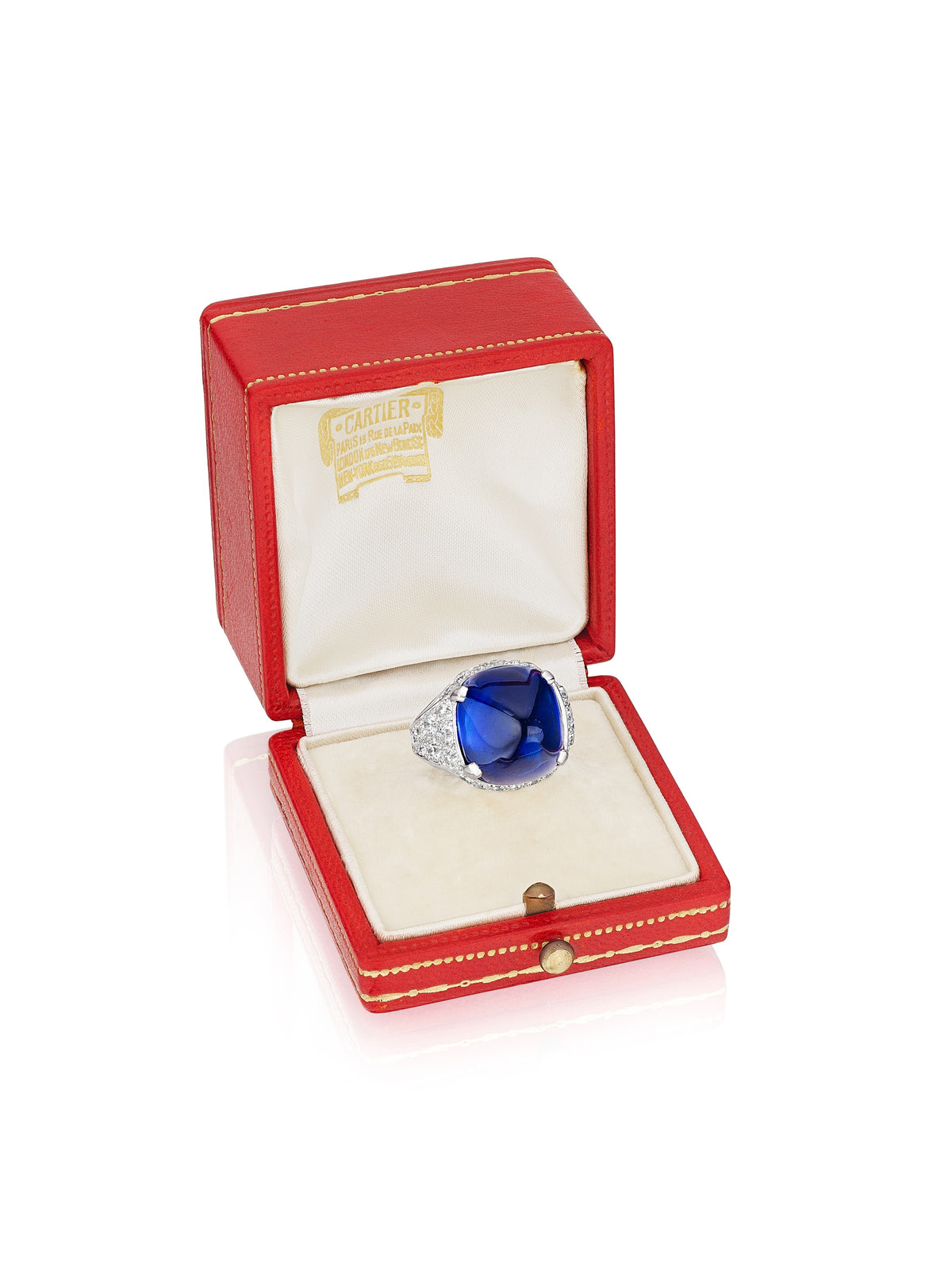


Art Deco Sugarloaf Sapphire and Diamond Ring by Cartier, Paris, circa 1930
Art Deco Sugarloaf Sapphire and Diamond Ring by Cartier, Paris, circa 1930
A ring centering a sugarloaf cabochon sapphire set with four prongs and surrounded by pavé diamonds; mounted in platinum, with French assay mark; in original Cartier fitted case
- 1 sugarloaf sapphire, weighing 23.09 carats
- Signed Monture Cartier, maker’s mark for Cartier
- Ring size: 5 1/4
Certification
AGL Report no. CS 1150478, dated 27 August 2025, stating that the 23.09 carat sapphire is of Burmese in origin with no indication of heating.
AGL Appendix stating, “Burmese sapphires of this color and character are commonly described as having a ‘Royal Blue’ color.” Further stating, “The 23.09 carat Classic™ Burma sapphire detailed in this AGL Prestige report is a gem worthy of special merit. Top-quality sapphires of this size and superior quality are exceedingly rare and the reason that the sapphires of Burma have earned their elite status.”
Biography
Cartier was founded in Paris in 1847 by Louis-François Cartier. His three grandsons, Louis, Pierre, and Jacques, built the house into a famous international jewelry empire serving royalty, Hollywood stars, and socialites. Cartier has created some of the most important jewelry and objects of art of the twentieth century with many iconic designs such as mystery clocks, Tutti Frutti jewelry and the Panthère line. In 1983, The Cartier Collection was established with the objective of acquiring important pieces that trace the firm’s artistic evolution. Today, Cartier has 200 stores in 125 countries.
Significance
The cabochon cut is one of the oldest techniques, dating back to ancient civilizations like Egypt, Mesopotamia, and Rome. Predating faceting, this early cut entailed painstakingly polishing the stone to bring out the natural color of the stone. The rare and beautiful sugarloaf cut is a refinement of the cabochon with a rounded four-sided pyramid shape named for the conical form sugar came in throughout most of history. The height of the sugarloaf cut allows more light to enter the stone, enhancing the natural beauty and velvetiness. Between the Middle Ages and the Industrial Revolution sugar was an expensive commodity reserved for wealthy families. This rare treat became associated with the sweet and beautiful sugarloaf cut for their shared elongated form, but also as objects of desire.
Cartier sourced this extraordinary stone during the Art Deco period and created a beautiful, strong geometric setting for the piece. Wide prongs hold the stone at the corners, above diamond-set shoulders in a V-shape, with a line of round diamonds extending across the gallery. Like windows, the diamonds allow more light to enter beneath the stone, while adding texture and sparkle to the design. Deceptively simple, this is a design that could only have been made by Cartier at the height of their design skill.
King Edward of England called Cartier “the jeweler of kings and the king of jewelers” referring to their mastery of design, use of important stones, and historical connection to royalty. This unparalleled sugarloaf sapphire ring perfectly fits with the important Art Deco output of the firm. Antique sugarloaf sapphires of this size and “Royal Blue” color are exceedingly rare. To find such a stone in an original Cartier design is extraordinary and would be an important addition to any collection.