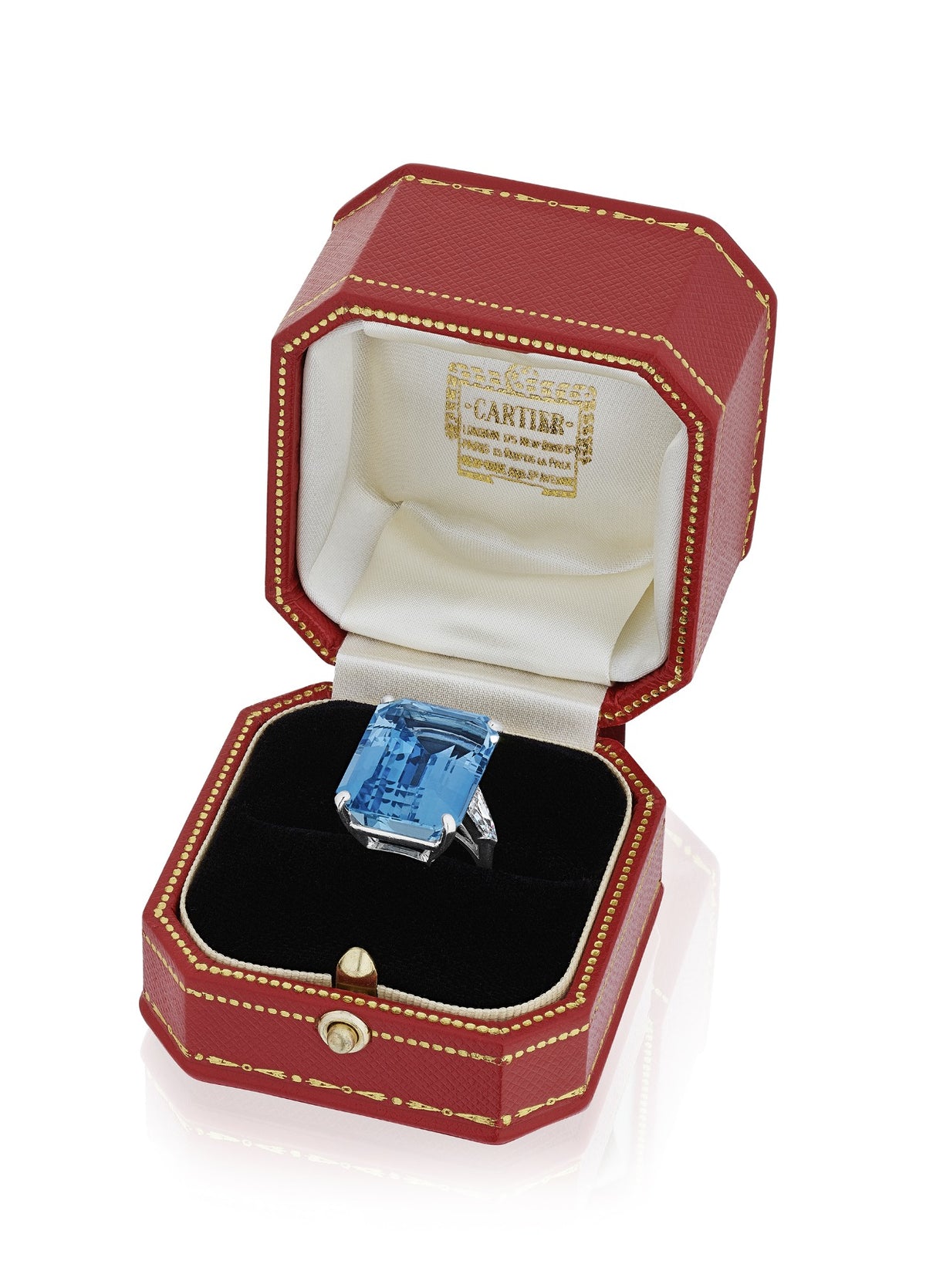


Art Deco Aquamarine and Diamond Ring by Cartier, circa 1935
Art Deco Aquamarine and Diamond Ring by Cartier, circa 1935
A ring centering a prong-set emerald-cut aquamarine, set on the shoulders with two tapered bullet-shaped diamonds; mounted in platinum, in a fitted box
- 1 emerald-cut aquamarine, weighing 27.45 carats
- 2 tapered bullet-shaped diamonds, weighing approximately 1.30 carats total
- Signed Cartier and numbered
- Aquamarine measurements: 7/8 × 5/8 inches
- Ring size: 6¼
Biography
Cartier was founded in Paris in 1847 by Louis-François Cartier. His three grandsons, Louis, Pierre, and Jacques, built the house into a famous international jewelry empire serving royalty, Hollywood stars, and socialites. Cartier has created some of the most important jewelry and objects of art of the twentieth century with many iconic designs such as mystery clocks, Tutti Frutti jewelry and the Panthère line. In 1983, The Cartier Collection was established with the objective of acquiring important pieces that trace the firm’s artistic evolution. Today, Cartier has 200 stores in 125 countries.
Significance
The Ancient Greeks and Romans associated the luminous blue stone aquamarine with the sea. Pliny the Elder, a Roman Historian and scientist wrote in his Naturalis Historia the romantic idea, “The lovely Aquamarine, which seems to have come from some mermaid’s treasure house, in the depths of the summer sea, has charms not to be denied.” Large pieces of the stone were so rare that craftsman reserved the stone for Imperial portraits that were coveted and later set in rings. In the 1930s, Cartier’s aquamarine jewels were in high demand, and they provided the stone in various forms including clips, tiaras, rings, necklace, and bracelets. In 1936 Vogue featured Cartier jewelry writing, “Aquamarines—limpid, glacial as the waters of a Northern lake—to play against a dress of white satin or the palest mauve mousseline.”
While Cartier London established their own workshops in 1921, throughout the 1920s jewelry was freely transferred between London and Paris. In 1929, that stopped because of two events, first, the Chancellor of the Exchequer established a duty on jewelry and second, brothers Jacques Cartier (London) and Louis Cartier (Paris) had a personal disagreement and Louis refused to send jewelry from Paris, sending only photos. Suddenly, Cartier London had the chance to find their own design style, and they became particularly known for wonderful aquamarines. This ring likely came from the London workshops.
In this jewel the large aquamarine is sided by bullet-shaped diamonds in a geometric composition covering the shoulders of the ring and creating a bold, statement meant to draw attention to the hand as it rested on the stem of a fluted glass or held a beaded purse against a biased cut silk dress. The idea of the cocktail ring became popular in the 1920s, when women seized social freedoms and began to work outside the home, take up sports, and socialize at nightclubs. This luminous aquamarine ring is just as eye catching as when it was created and would make a magnificent and wearable addition to any collection.