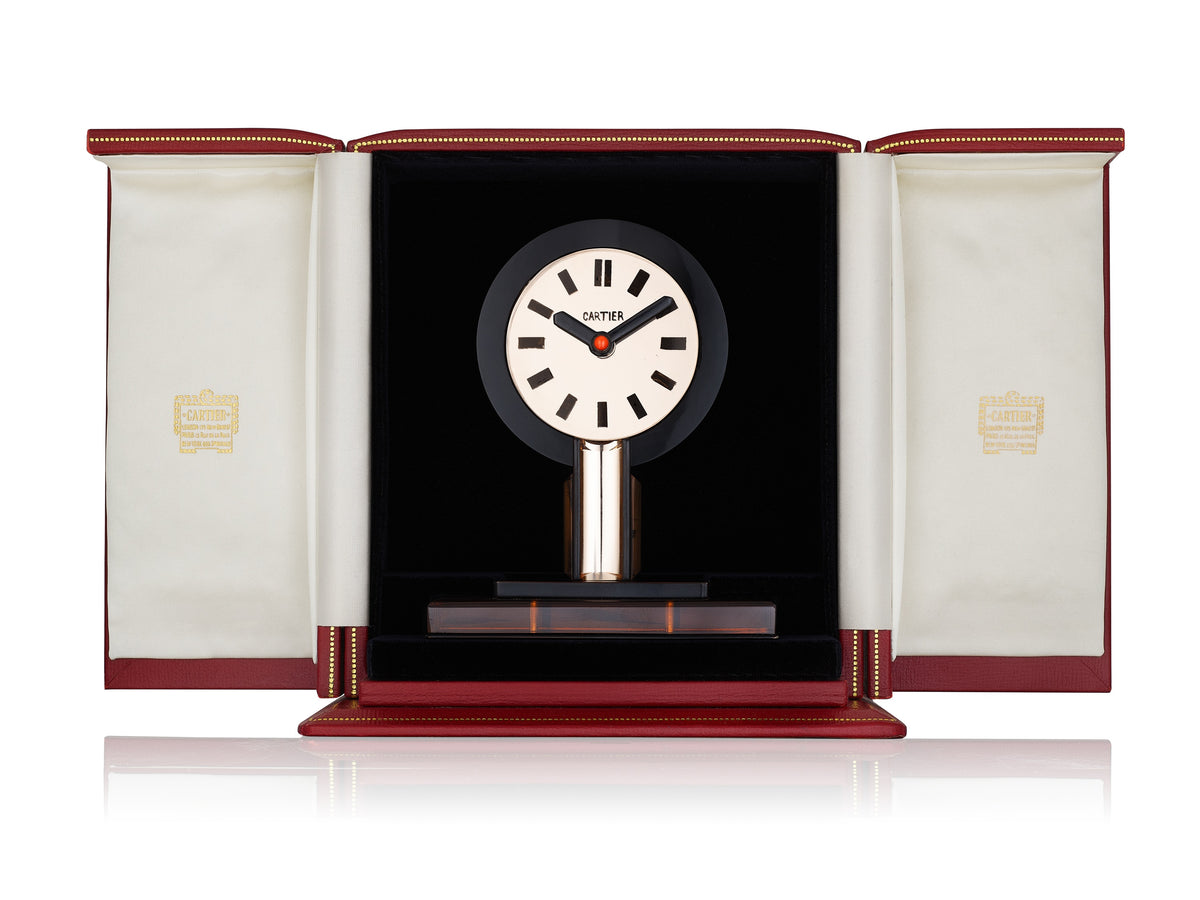


Art Deco Onyx and Amber Glass Pendulette Desk Clock by Cartier, Paris, circa 1930
Art Deco Onyx and Amber Glass Pendulette Desk Clock by Cartier, Paris, circa 1930
A clock composed of an onyx hardstone and amber mirrored glass, with enamel chapter markers and black hands centering a coral button, on a base of blackened silver and amber glass; in a fitted case
- Face signed Cartier, base numbered and hallmarked
- Measurements: 4” x 2 3/4 × 5 inches
Biography
Cartier was founded in Paris in 1847 by Louis-François Cartier. His three grandsons, Louis, Pierre, and Jacques, built the house into a famous international jewelry empire serving royalty, Hollywood stars, and socialites. Cartier has created some of the most important jewelry and objects of art of the twentieth century with many iconic designs such as mystery clocks, Tutti Frutti jewelry and the Panthère line. In 1983, The Cartier Collection was established with the objective of acquiring important pieces that trace the firm’s artistic evolution. Today, Cartier has 200 stores in 125 countries.
Significance
The 1920s and 1930s were a time of great technological advancement. The fascination with new machines was reflected in the bold streamlined shapes of the late Art Deco period, known as Art Moderne. Coming off the curves and elaborate foliate decoration of previous decades, the straight lines of modern designs were shocking. Even more so as artists associated with the Union des Artistes Modernes (UAM), such as Jean Puiforcat and Jean Fouquet, eschewed extraneous decoration in favor of austere and inventive pieces. Cartier, known for elaborate gem-set creations, were aware of the Bauhaus-influenced movement toward austerity and the idea that “form follows function.”
By the end of the 1920s, Jeanne Toussaint had established the “S Department” at Cartier to create fantastic utilitarian objects such as handbags, vanity cases, and smoking accoutrements, made without the elaborate stones and trimmings of the costliest Cartier creations. Toussaint’s streamlined designs became popular, and particularly during the Great Depression of the 1930s, the austere nature of such pieces helped make the S Department integral to the continued success of Cartier. At one time, the department accounted for nearly one third of Cartier’s sales. This clock is a rare example of a timepiece created by the Department.
This magnificent clock shows that Toussaint was aware of what was happening on the design forefront and is as unusually bold and austere as something from a UAM designer might be. The clock alternates between dark and light surfaces that are mirrored or opaque, creating a study of both light and stacked geometry of circles and rectangles. By 1930s, electricity was becoming common in the home and thus the lights could be on well into the night. This clock was designed with a streamlined simplicity in mind, but the use of mirrored sections was a technical achievement designed to catch and play with light. Deceptively simple, this rare and beautiful example of an Art Deco desk clock by Cartier would be a shining addition to any collection.