Literature
cf. Chaille, François. The Cartier Collection: Precious Objects. Paris, Éditions Flammarion, 2012, p. 189.
Biography
Cartier was founded in Paris in 1847 by Louis-François Cartier. His three grandsons, Louis, Pierre, and Jacques, built the house into a famous international jewelry empire serving royalty, Hollywood stars and socialites. Cartier has created some of the most important jewelry and objects of art of the twentieth century with many iconic designs such as mystery clocks, Tutti Frutti jewelry and the Panthère line. In 1983, The Cartier Collection was established with the objective of acquiring important pieces that trace the firm’s artistic evolution. Today, Cartier has 200 stores in 125 countries.
Significance
Since Cartier was founded in 1847, the company has offered beautiful objects for sale amongst their exquisite jewelry. Reading, writing, and desk implements were offered by the 1860s. The founder of the firm, Louis-François Cartier, was interested in and inspired by Far Eastern languages and he spent time studying them toward the end of his life. According to Cartier, “He instilled his descendants with the idea that culture is the most important of all values, and that writing is the defining mark of all civilizations.”
The paperknife became an important desk tool in the 1800s. Paper had become far more commonplace than in earlier eras and the new Stanhope presses printed books on long reams of uncut paper that were folded into a zig zag, hand bound on one side and hand cut on the other. A missed cut was a common occurrence, and the paper knife was an essential tool to tear these folds gently and precisely.
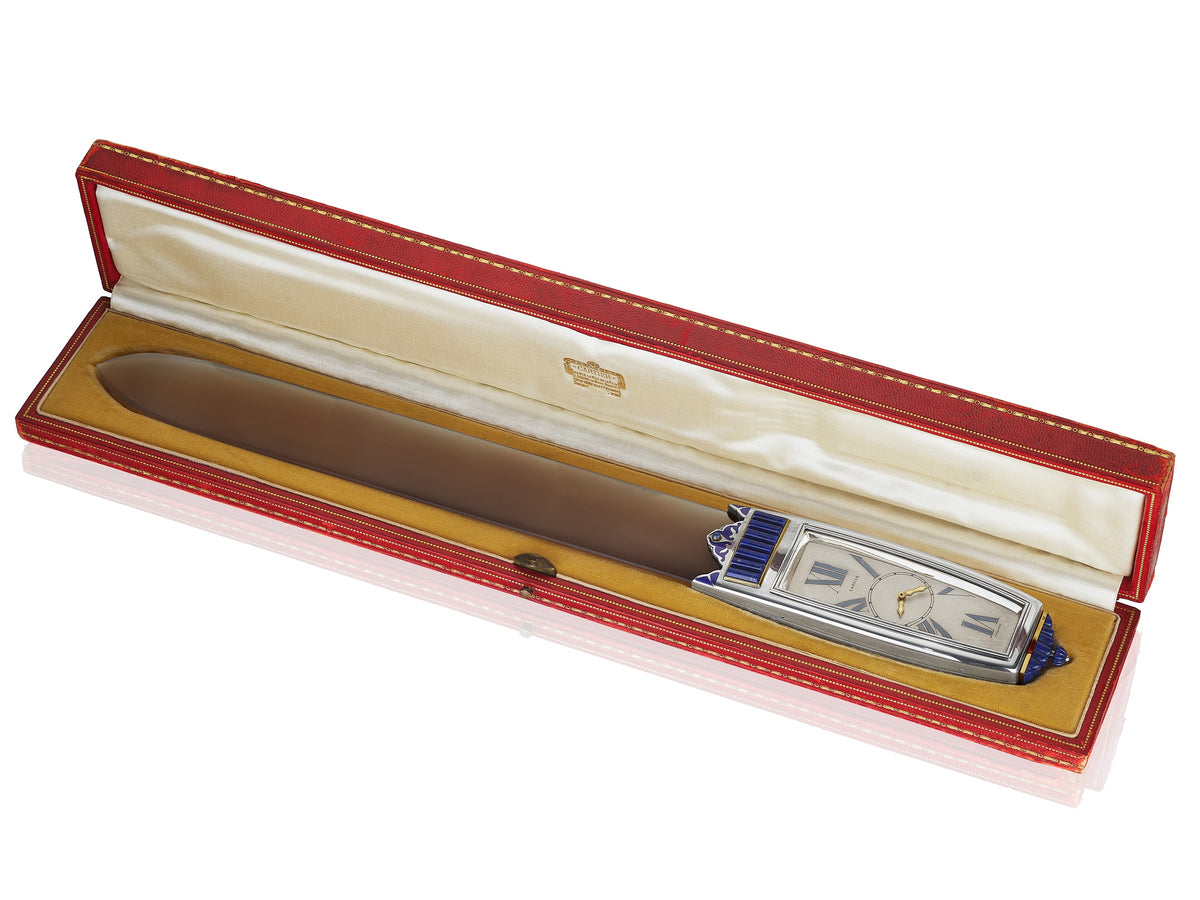
In 1928, Cartier created this wonderful paperknife-clock desk object that was engraved to be gifted on Christmas. Book trimming had become more reliable, but even today you may occasionally find a book that has not been properly cut. The shape of the object was delightful to see and to hold, and Cartier added to the beauty and functionality by incorporating a clock with a touch of exotic design in the decorative details. A few of these objects were made, and an identical model in the Cartier Collection has been sought after for several museum exhibitions. In 1935, the playwright Noel Coward was photographed working at his desk with a Cartier paperknife at his side. He was known for both his talent and taste; Time magazine said Coward had, “a sense of personal style, a combination of cheek and chic, pose and poise.” This fantastic Cartier paperknife would add elegance to any desk.