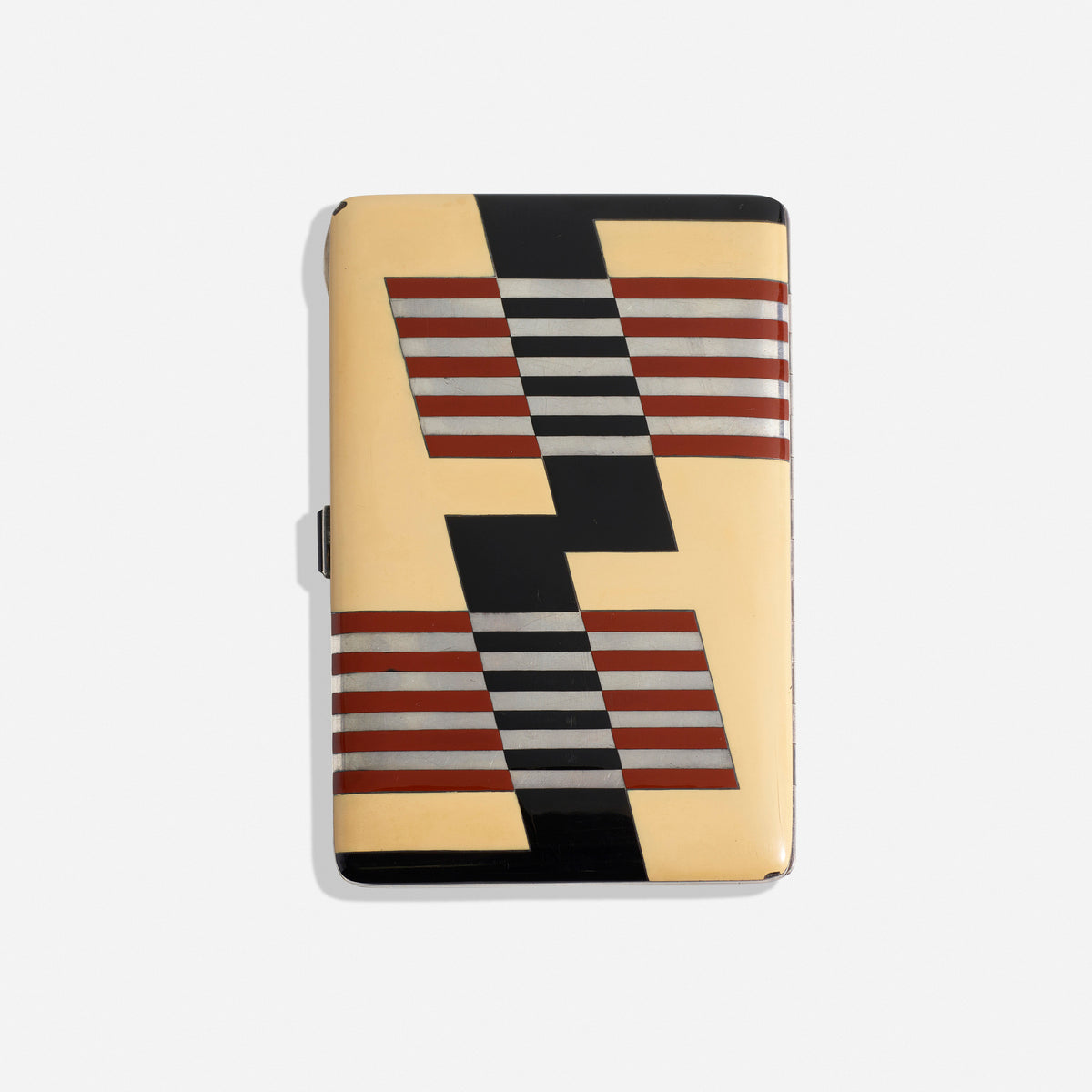


Art Deco Silver and Lacquer Cigarette Case by Gérard Sandoz
Art Deco Silver and Lacquer Cigarette Case by Gérard Sandoz
A cigarette case of geometric Art Deco design, featuring a striking lacquer design on silver with bold zigzag patterns and horizontal stripes in black, red, and white
- Incised signature to inner edge ‘Gerard Sandoz’
- Measurements: Height 5 × 3½ x ⅜ inches
Biography
Art Deco designer Gerard Sandoz was born into a family of clockmakers and jewelers in Paris in 1902. Instructed in modern art by his uncle Paul Follot, he contributed designs to Maison Sandoz from an early age. Also a poster designer and painter, his graphic in)uence is evident in his jewelry and objects. He exhibited at the 1925 Paris Exposition Internationale des Arts Décoratifs et Industriels Modernes and was a founding member of the Union des Artistes Modernes (UAM) in 1929, an important group that challenged the established traditions of design. He closed the *rm in 1931 to focus on painting and cinema.
Significance
+e 1920s were a time of glamour, when it was chic to accessorize with artfully designed accoutrements. Cigarette cases, compacts, lipstick cases, and perfume bottles were carried in the hand or slipped into a pocket or bejeweled handbag and later taken out and placed on a table. Whether taken out or kept on a vanity, the objects complemented the fashions of the era with long, )at silhouettes patterned with solid and graphic designs. +ese accessories were status symbols, miniature works of art reminiscent of precious objects created during the Renaissance.
Precious objects from the Art Deco period were decorated with similar techniques as those employed in *ne jewelry, including enamel and lacquer. Gerard Sandoz created both jewelry and objects and used the metal surfaces as a canvas to be covered with brightly colored enamel. A founding member of the UAM, he was an early proponent of modernism, creating exquisite work from modest materials that were strongly based on geometric forms. He is known equally for his jewelry composed of stripped-down geometric forms and for his wonderful cigarette cases decorated with abstract geometric designs, machine- like parts, or the occasional street scene.
Sandoz’s work is instantly recognizable, primarily for its distinctive enamel work. Iconic of the Art Deco period, his designs are coveted by collectors, but since he only created jewelry and objects for about 10 years, from 1920 to 1930, they are exceedingly rare. +is cigarette case features Sandoz’s signature use of geometry and colored enamel work and is a testament to his innovative approach to design. More than a utilitarian object, this cigarette case is a work of art.