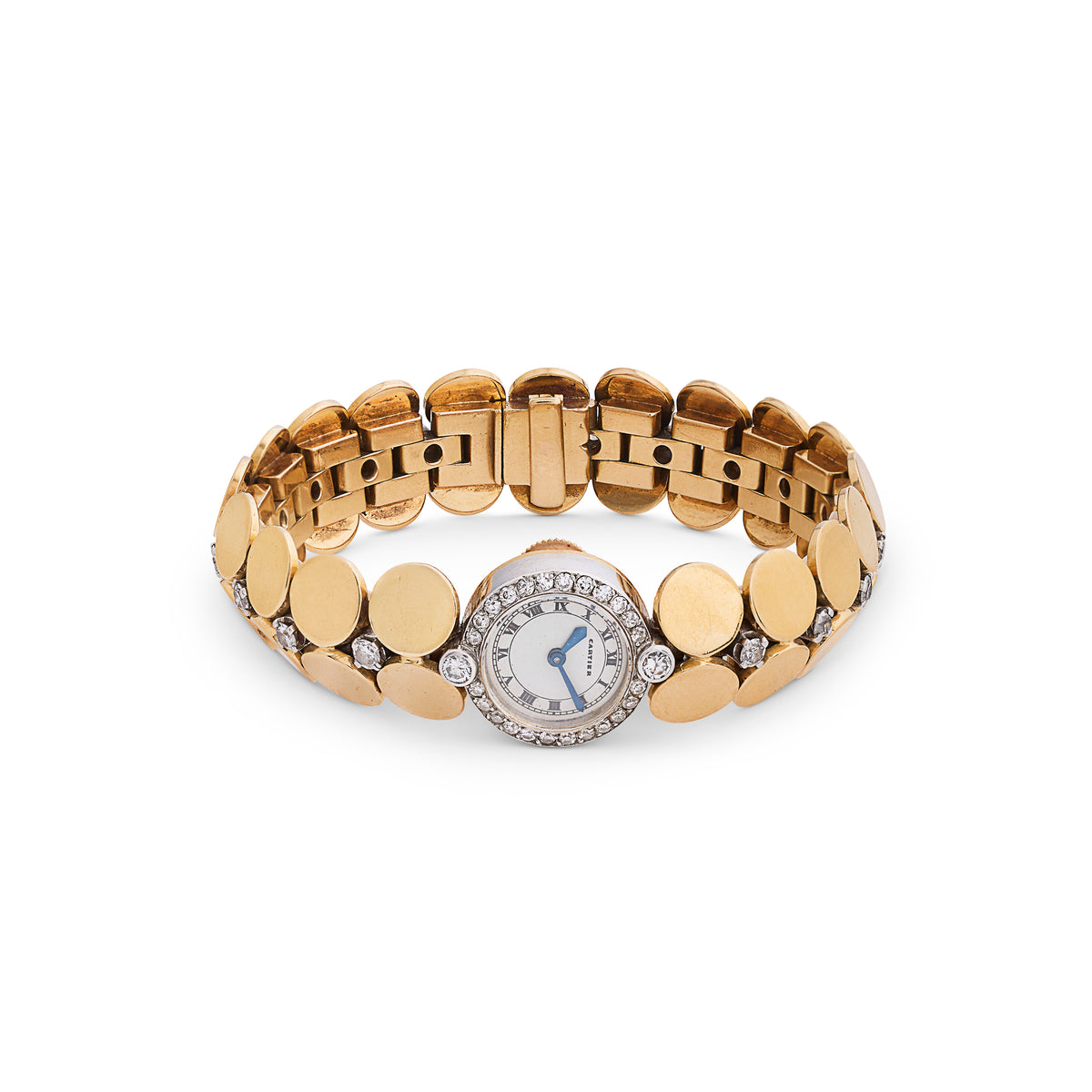


Gold and Diamond Bracelet Watch by Cartier, Paris, circa 1950
Gold and Diamond Bracelet Watch by Cartier, Paris, circa 1950
A bracelet watch centering a circular silvered dial with Roman numerals and blued steel hands, within a diamond-set bezel, the case integrated into a bracelet composed of articulated polished gold oval links separated by diamond-set spacers; mounted in 18-karat yellow gold and platinum, with French assay marks, in a fitted box.
- Signed Cartier Paris
- Case numbered
- Movement by European Watch & Clock Co.
- Case diameter: ½ inch; bracelet length: 6 inches
Biography
Cartier was founded in Paris in 1847 by Louis-François Cartier. His three grandsons, Louis, Pierre, and Jacques, built the house into a famous international jewelry empire serving royalty, Hollywood stars, and socialites. Cartier has created some of the most important jewelry and objects of art of the twentieth century with many iconic designs such as mystery clocks, Tutti Frutti jewelry and the Panthère line. In 1983, The Cartier Collection was established with the objective of acquiring important pieces that trace the firm’s artistic evolution. Today, Cartier has 200 stores in 125 countries.
Significance
In the years following the Second World War, Cartier increasingly approached the bracelet watch as a unified object of jewelry, subordinating the dial to surface, articulation, and continuity of form. Rather than emphasizing timekeeping as a visual feature, these works privilege rhythm and material presence, allowing gold and diamonds to define the composition.
This example is characterized by its integrated construction, in which the circular case is absorbed seamlessly into the surrounding links. The alternating sequence of polished gold ovals and diamond-set spacers establishes a measured cadence around the wrist, balancing softness with precision. The modest scale of the dial reinforces the jewelry-first approach that defines Cartier’s mid-century bracelet watches.
Bracelet watches of this type reflect a broader postwar design language in which refinement, discretion, and sculptural restraint were central concerns. Within Cartier’s production of the period, such works illustrate the firm’s ability to translate bold gold jewelry into forms that merge ornament and function while maintaining clarity and cohesion of design. Within a collection, such works contribute to a fuller understanding of Cartier’s postwar approach to sculptural gold jewelry and timepieces.